
In industrial hygiene operations, ensuring the best washing performance requires balancing four key variables: temperature, chemistry, time, and mechanical action. These interdependent elements form the foundation of the Sinner’s Circle Theory – a core principle for wash process optimization.
When one factor increases, the others can be reduced while still achieving high-quality results. That’s where temperature control becomes especially powerful: it influences all other parameters, unlocking new levels of efficiency, precision, and performance.
Why temperature is essential in wash process optimization
Temperature plays a critical role in both the activation of cleaning agents and the solubility of contaminants, directly impacting stain removal and disinfection. However, its influence doesn’t stop there.
By monitoring and controlling temperature – especially using smart tools like CM2W’s wireless temperature sensor – you can fine-tune the entire wash cycle, reduce resource consumption, and improve both wash quality and customer satisfaction.
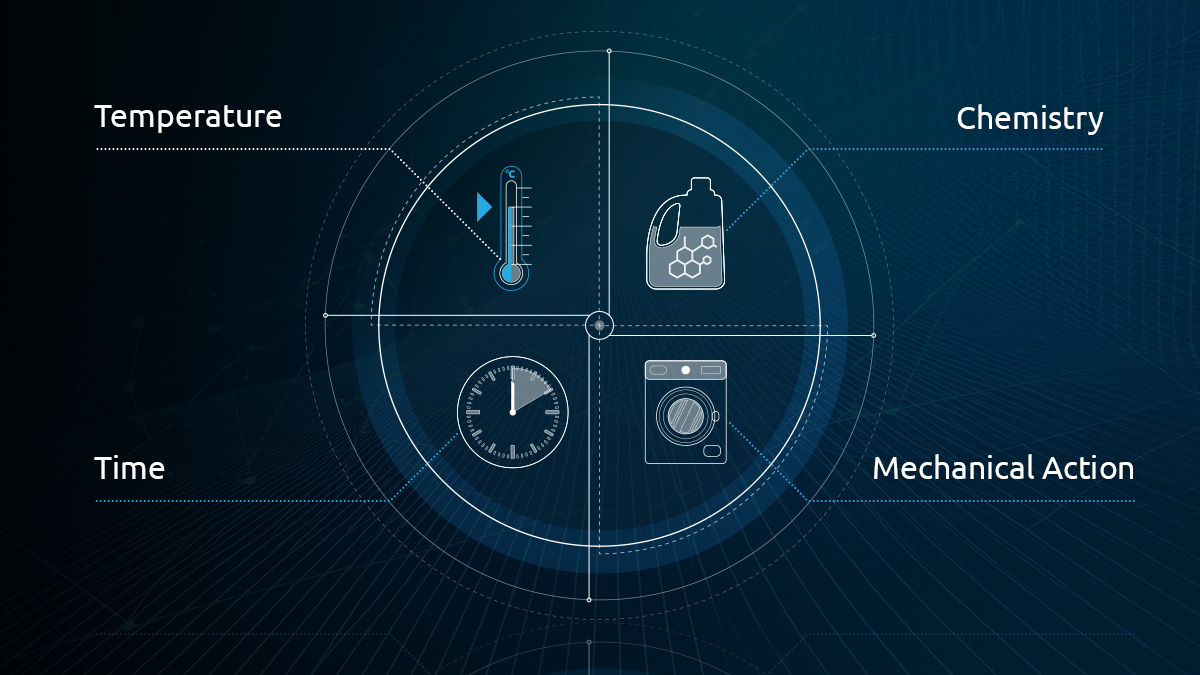
Sinner’s Circle diagram showing temperature, chemistry, time, and mechanical action in balance.
Let’s explore how temperature affects each element of the Sinner’s Circle:
1. Impact on chemistry: Activate detergents at the right time
Different detergents are designed to activate at specific temperature thresholds. Likewise, various stains respond better to targeted thermal conditions.
By tracking real-time temperature during the wash cycle, you can precisely time detergent dosing, ensuring that each chemical activates exactly when needed. This not only improves wash results but also helps reduce chemical waste.
2. Impact on time: Achieve better results, faster
While longer wash cycles often yield better cleaning, they also consume more energy and reduce equipment lifespan.
Accurate temperature monitoring enables faster chemical activation and shorter program durations – helping businesses achieve desired results in less time. This means reduced electricity usage, lower machine wear, and greater operational efficiency.
3. Impact on mechanical action: Reduce textile wear and detect issues
Optimizing wash time through temperature control also reduces mechanical friction and textile wear, extending the life of linens and garments.
Additionally, monitoring the heating rate of washer-extractors helps detect technical malfunctions early, preventing unplanned downtime and maintaining wash quality.
Wireless temperature monitoring with CM2W
To help hygiene businesses gain full visibility and control, CM2W developed a wireless IoT temperature sensor designed specifically for industrial applications.
This sensor offers:
- Real-time temperature tracking across all wash stages (pre-wash, main wash, rinse, etc.)
- Wireless installation for easy deployment without infrastructure changes
- Monitoring of heating rate to detect machine inefficiencies or faults
- Temperature-based dosing, integrated with CM2W’s IoT-enabled controllers, to trigger each detergent precisely at its optimal temperature
All insights are visualized through CM2W’s intuitive web interface, providing live dashboards, proactive alerts, and performance trends for smarter decision-making.
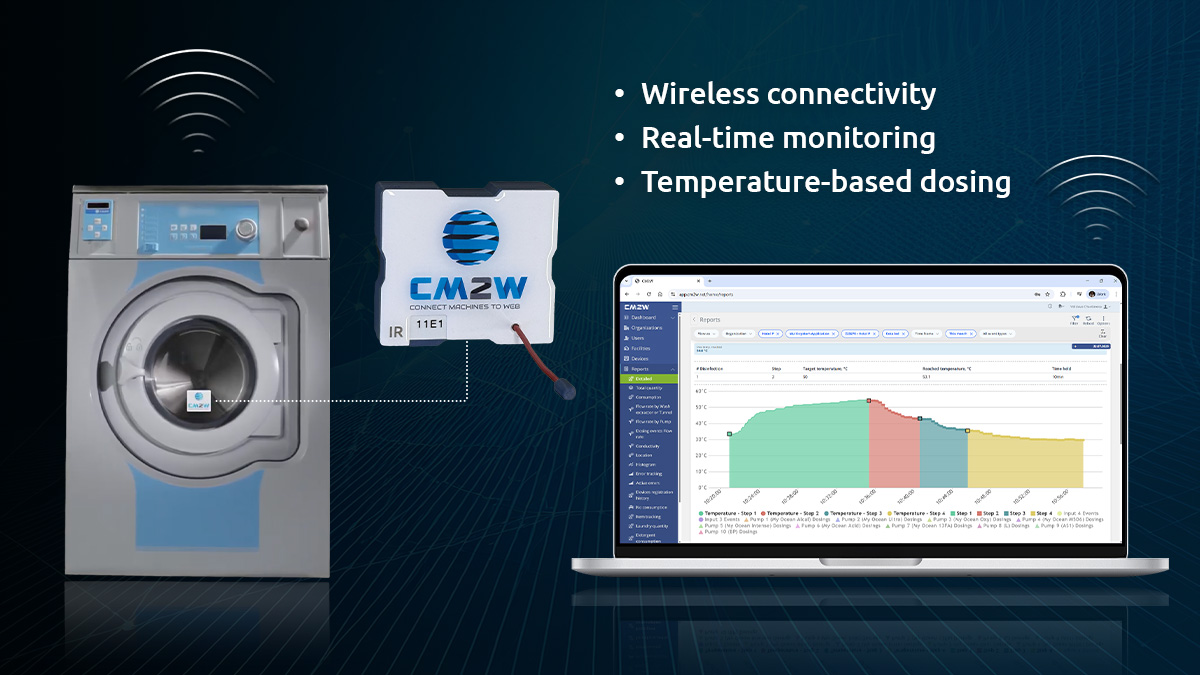
CM2W wireless temperature sensor for industrial washing with real-time monitoring and temperature-based chemical dosing.
Final thought: Turn heat into an asset
Temperature isn’t just a variable – it’s a strategic lever for smarter hygiene operations. With the right tools and data, you can transform your washing process from generic to optimized, from reactive to predictive.
Ready to take control of temperature in your hygiene operations? Learn more about our wireless sensor and IoT-enabled solutions at cm2w.net or contact us at info@cm2w.net.